
Ask a chatbot for a twist ending to your small-town mystery and you’ll have one in seconds. The sheriff did it, or the victim faked her own death, or the narrator was the killer all along. All usable, all used a thousand times before, which tells you most of what you need to know about AI and fiction.
These tools are genuinely useful to novelists in a few specific ways. They’re also bad at the parts of writing that make a book worth reading, and knowing which is which saves a lot of wasted afternoons.
Where it actually helps
Asking better questions, not handing you answers
The most productive way to brainstorm with AI isn’t asking it for ideas. It’s asking it to interrogate yours. Describe your antagonist, then ask for twenty questions a skeptical reader might have about her motives.
Most will be obvious. Two or three will point at a hole you hadn’t noticed, and since you’re the one answering, the book stays yours.
Research you’ll double-check anyway
Say your 1970s thriller needs a scene in a Soviet train station. You want to know roughly what the ticket hall looked like, what people carried, how long the overnight run from Moscow to Leningrad took. An AI assistant can give you a fast orientation and a list of things to look up.
Orientation is the key word. Language models state wrong things with total confidence, and some will cheerfully invent a source. Treat the output as a map of what to verify, then verify it somewhere reliable.
Seeing a whole manuscript at once
This is where the software has improved the most. A 90,000-word draft is too long for anyone to hold in their head in one sitting, and that’s exactly where continuity errors hide.
Your detective’s partner has a daughter in chapter 3 and a son in chapter 21. A character drives to a meeting on the same night her car was towed. The middle third drags and you can’t work out why.
Manuscript analysis tools can read the whole draft and flag that kind of problem: timeline contradictions, pacing dips, a chapter three times longer than its neighbors, a payoff with no setup. You still do the fixing. What you get is a list of places to look, which is roughly what an editor’s first read gives you too.
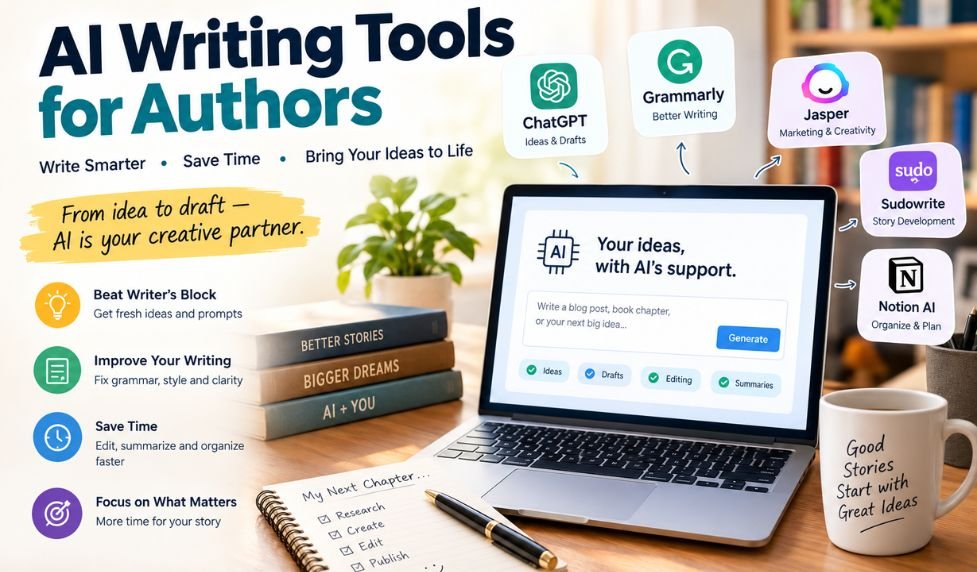
If you’re comparing options, a roundup of AI writing tools for authors that sorts them by what they actually do is worth a look. The label covers everything from grammar checkers to full text generators.
Line edits, with a grain of salt
Grammar and style assistants catch repeated words, tangled clauses, the paragraph where “just” appears six times. They’re good at the mechanical layer.
They also tend to sand everything into the same smooth, faintly corporate register. Accept suggestions one at a time and reject freely.
Where it falls down
Voice is the obvious one. A novelist’s voice is a pile of thousands of small, slightly odd choices: the words you reach for and the ones you avoid, where you put the joke, how long you let a silence run. Language models are built to predict the likely next word, and voice lives in the unlikely one.
Taste goes with it. AI can tell you a scene is slow. It can’t tell you whether the slowness is the point, whether this is the quiet chapter before everything breaks and it’s supposed to feel like a held breath.
Emotional truth is harder still. Generated prose about grief tends to hit every expected note (the empty chair, the phone nobody answers) and land none of them.
Grief on the page is usually specific and a bit wrong-footed. Someone laughs at the funeral. Someone gets furious about a parking ticket the day after.
Those details come from lived experience or close observation, not from an average of everything already written. And underneath all of it, the software doesn’t know what your book is for. That question, what this story is trying to say and to whom, shapes every revision decision, and only the writer can answer it.
Assisting versus generating
The most practical line to draw is between AI that helps you work on your own writing and AI that writes for you. Asking a tool to find continuity errors, question your plot or flag clumsy sentences is assistance. Asking it to draft chapter nine is generation, and the prose that comes back isn’t really yours.
The distinction has practical consequences too. Amazon’s Kindle Direct Publishing asks authors to disclose AI-generated content, meaning text, images or translations created by an AI tool, when they publish.
Work you wrote yourself and then used AI to edit, refine or error-check counts as AI-assisted under KDP’s guidelines, and that doesn’t need disclosing. Other retailers, contests and literary magazines set their own rules, so read the fine print before you submit.
Readers have opinions here too. Plenty of people pick up a novel precisely because a person wrote it, and they tend to notice when the person seems to be missing.
A sensible way to use it for now
Write the draft yourself. Then bring AI in as a reader with a very good memory and no taste, something to catch the timeline slip in chapter 14, ask awkward questions about your villain, and point you toward research you’ll check. Every decision about what the story means and how it sounds stays on your side of the desk.
Here’s a quick test after any session. If the chapter now sounds like everyone else’s book, close the tab. If it sounds like yours, only cleaner and more consistent, you’re using the tool for what it’s good at.


